Why Your Plant Isn’t Growing (Even Though It Looks Healthy)
How one juvenile Black Majesty Philodendron taught me that healthy growth begins long before a new leaf appears.
Sometimes the hardest part of growing plants is learning to wait.
Five months ago, I brought home a juvenile Black Majesty Philodendron with three healthy leaves.
Like many excited plant collectors, I wanted to give it the best possible start. About a week after bringing it home, I repotted it. At the time, I thought I was helping the plant settle into its new home.
Looking back, I realize it may have been too soon. The plant was still adjusting to a new environment, and before it had a chance to acclimate, I asked it to adapt all over again.
Over the following weeks, the older leaves slowly declined until only one remained.
Watching that happen was frustrating. Not because the plant was dying… But because it simply stopped growing.
If you’ve ever looked at a healthy-looking plant that hasn’t produced a new leaf for months, you probably know exactly how that feels.
For Four Months, I Chose to Wait
My first reaction wasn’t to buy another product or immediately look for a solution. I simply observed.
I watered the plant consistently. I monitored its condition.
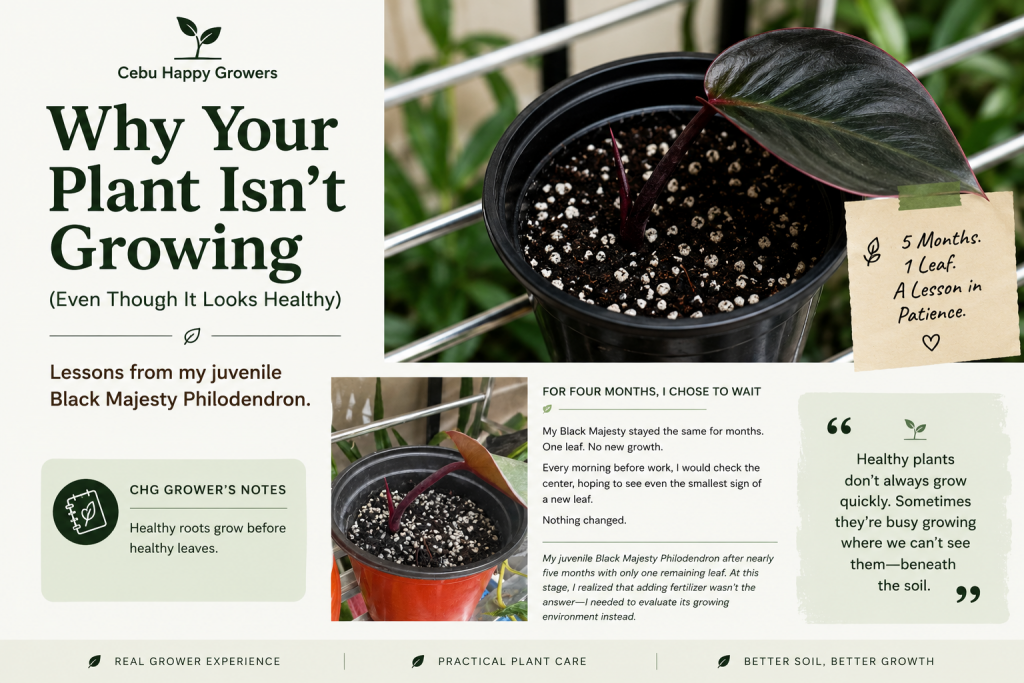
Every day before work, I found myself checking the center of the plant, hoping to see even the smallest sign of a new leaf.
Nothing changed. Week after week. Month after month.
The plant stayed exactly the same. One healthy leaf. No new growth.
Then I Thought It Might Need Fertilizer
After nearly four months without seeing any progress, I wondered if the plant had simply used up the nutrients in its potting mix.
So I fertilized it.
What surprised me was how quickly many of my other plants responded. Several of them produced fresh new leaves within weeks.
My Black Majesty didn’t. Not even a tiny change.
That was the moment I realized something important.
The fertilizer wasn’t the problem. It simply wasn’t the missing piece.
That’s When I Stopped Looking for Products and Started Looking for the Cause
Instead of asking, “What should I add?” I started asking, “What could I improve?”
Looking back, I realized there wasn’t one obvious mistake.
There were several small factors that may have worked together to slow the plant’s recovery.
1. I Repotted It Too Soon
Moving into a new home is already stressful for any plant.
Repotting only a week later may have added another adjustment before the plant had fully settled into its new environment.
Some plants recover quickly. Others take much longer.
Sometimes that recovery happens beneath the soil long before we see it above the surface.
2. I Used the Soil Mix I Had Available
When I repotted my Black Majesty, I used our 6N1 Cactus & Succulent Mix.
Not because I believed it was the ideal mix for philodendrons. It was simply the potting mix I had readily available at the time.
The plant survived.
But after months without any new growth, I started questioning whether I had given it the best environment to thrive.
That’s when I reminded myself of something we often tell our own customers:
The best soil isn’t the one you have on hand. It’s the one that’s formulated for the plant you’re growing.
Our 6N1 Cactus & Succulent Mix is designed for plants that naturally prefer faster-draining conditions and shorter periods of moisture around their roots.
A juvenile Black Majesty, like many philodendrons and other aroids, generally performs better in a mix that balances excellent drainage with enough moisture retention to support steady root development.
Looking back, I believe one of our aroid mixes would have been a better match for this plant.
Does that mean the soil mix alone caused the slow growth? Probably not.
But it reminded me that matching the potting mix to the plant is just as important as choosing a quality mix.
3. Light Matters More Than We Often Realize
For several months, my Black Majesty sat on a shelf where it received filtered light, but probably not enough to encourage active growth.
The plant wasn’t in complete shade. It simply wasn’t in the brightest filtered location available.
Instead of adding more fertilizer, I’ve recently moved it to a brighter spot where it can receive more consistent filtered light.
Sometimes improving the environment is more effective than adding another input.
4. Healthy Plants Don’t Always Grow on Our Schedule
One of the biggest misconceptions in gardening is that a healthy plant should always be producing new leaves.
That’s simply not true.
Plants recovering from stress often spend weeks—or even months—rebuilding their root systems before producing visible growth.
Roots grow quietly. Leaves are simply the part we notice.
Then Something Finally Changed
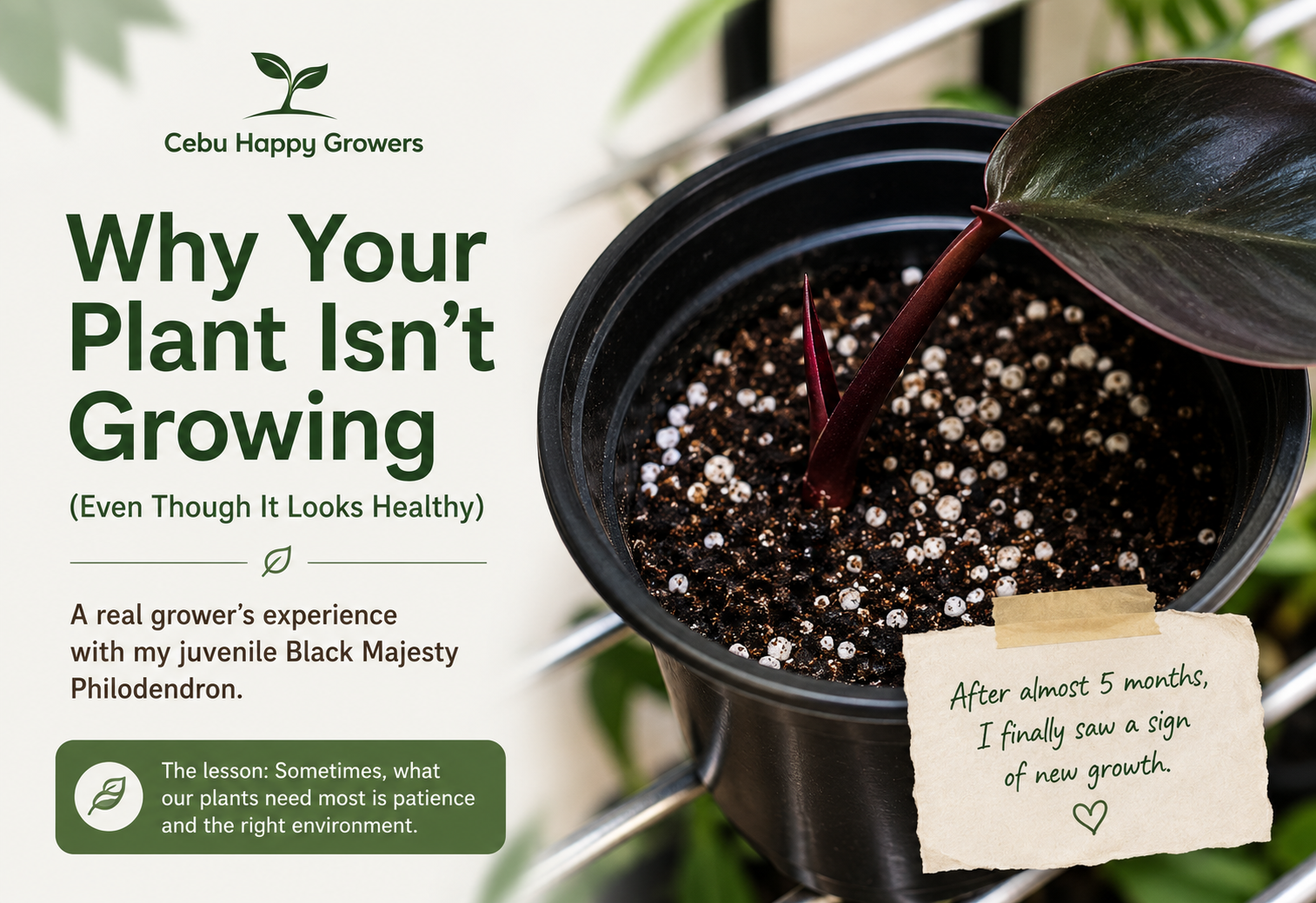
A few days ago, while checking my Black Majesty, I noticed something I had been waiting months to see.
A small reddish spear emerging from the center of the plant. It hasn’t opened into a new leaf yet.
But after five months of waiting, it represents something far more important than a new leaf. It represents progress.
Sometimes growth doesn’t happen all at once. Sometimes it begins with the smallest signs.
What My Black Majesty Taught Me
This experience changed the way I approach plant care.
I learned that:
- Fertilizer can’t replace the right growing conditions.
- The right soil mix matters because different plants have different needs.
- Bright filtered light encourages growth in ways fertilizer never can.
- Healthy roots are built before healthy leaves appear.
- Patience isn’t just part of gardening—it is gardening.
Most importantly…
I learned that not every slow-growing plant needs another product.
Sometimes it simply needs a better environment and enough time to respond.
Final Thoughts
Today, my juvenile Black Majesty still has one leaf. But I no longer see that as failure.
I see it as a reminder that healthy plants don’t grow according to our timeline. They grow when they’re ready.
Sometimes the most important growth is happening where we can’t see it. Beneath the soil.
As growers, we don’t become better by never making mistakes.
We become better by observing our plants, learning from them, and sharing those lessons with others.
At Cebu Happy Growers, that’s exactly what we hope to do—help growers understand not just what to do, but why it matters.
Because healthy plants don’t begin with more products.
They begin with the right foundation.